Ha Giang Water-Pouring Season – Best Time & Rice Terrace Views
Discover Ha Giang's water-pouring season around May and June, with reflective rice terraces in Hoang Su Phi, Ban Luoc, Ban Phung and Thong Nguyen.
- When Is Water-Pouring Season in Ha Giang?
- 1. Hoang Su Phi – A Highlight of Water-Pouring Season
- 2. Ban Luoc – Layered Mountain Terraces
- 3. Ban Phung – Sunrise Over the Terraces
- 4. Thong Nguyen – Rice Terraces & Village Life
- 5. Nam Ty – Peaceful Highland Landscapes
- Water-Pouring Season vs Golden Rice Season
- Best Time of Day for Photography
- Is Water-Pouring Season Good for Photography?
- Suggested 2-Day Itinerary
- Suggested 3-Day Itinerary
- Tips for Ha Giang Water-Pouring Season
- Can You Combine It with the Ha Giang Loop?
- FAQ – Ha Giang Water-Pouring Season
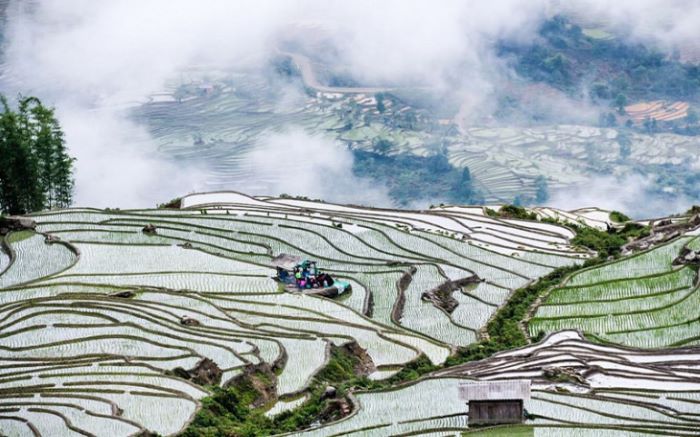
Ha Giang's water-pouring season is the period when water is directed into terraced rice fields in preparation for a new growing season.
The flooded terraces reflect the sky, clouds and surrounding mountains, creating a completely different landscape from the golden rice fields seen later in the year.
When Is Water-Pouring Season in Ha Giang?
The season is generally associated with May and June, when farmers begin bringing water into the terraces before planting rice.
Exact timing varies depending on rainfall, water availability and local farming schedules. Travelers visiting specifically for flooded terraces should check current conditions shortly before departure.
1. Hoang Su Phi – A Highlight of Water-Pouring Season
Hoang Su Phi is well known for extensive terraced rice fields across its mountain slopes.
During water-pouring season, the terraces become natural mirrors, reflecting the sky and surrounding landscape.
2. Ban Luoc – Layered Mountain Terraces
Ban Luoc features wide areas of rice terraces following the contours of the mountains.
When filled with water, the layered fields create impressive curves and reflections when viewed from elevated positions.
3. Ban Phung – Sunrise Over the Terraces
Ban Phung is popular among travelers interested in landscape photography.
Early morning light reflecting across flooded terraces, with mountains and villages in the background, can create particularly beautiful scenery.
4. Thong Nguyen – Rice Terraces & Village Life
Thong Nguyen is suitable for travelers looking to combine terraced landscapes with quieter village experiences.
It works especially well for a slower itinerary with local homestays and countryside exploration.
5. Nam Ty – Peaceful Highland Landscapes
Nam Ty also features terraced fields surrounded by mountain scenery and villages.
During water-pouring season, the reflections across the fields become especially noticeable on clear days.
Water-Pouring Season vs Golden Rice Season
- Water-pouring season: reflective flooded terraces, generally around May–June
- Green rice season: terraces become increasingly green as the rice grows
- Golden rice season: yellow harvest landscapes, commonly around September–early October
Best Time of Day for Photography
- 5:30 – 7:30 AM: sunrise, mist and softer light
- 8:00 – 10:00 AM: clearer views for sightseeing
- 4:00 – 6:00 PM: afternoon reflections across the terraces
Sunrise and sunset times change throughout the season, so these times should be treated as general guidance.
Is Water-Pouring Season Good for Photography?
Yes. It is especially interesting for landscape photographers because the flooded terraces create natural reflections.
Elevated viewpoints can help reveal the curves and layered structure of the terraced fields.
Suggested 2-Day Itinerary
- Day 1: Travel to Hoang Su Phi – Thong Nguyen – terrace sightseeing – homestay
- Day 2: Ban Luoc or Ban Phung – sunrise photography – village visit – return
Suggested 3-Day Itinerary
- Day 1: Travel to Hoang Su Phi – stay around Thong Nguyen
- Day 2: Ban Luoc – Ban Phung – terraced rice viewpoints
- Day 3: Nam Ty or another suitable village – local experience – return
Tips for Ha Giang Water-Pouring Season
- Check current field conditions before traveling
- Bring rain protection during this wetter period
- Wear shoes with good grip around terrace paths
- Do not enter fields without permission
- Avoid unnecessary night travel on mountain roads
- Check weather and road conditions before departure
- Respect local farming activities
Can You Combine It with the Ha Giang Loop?
Yes, but allow enough time. Hoang Su Phi and the classic Dong Van – Ma Pi Leng – Meo Vac route cover different parts of the region.
A trip of around 5–7 days is more comfortable if you want to experience both the western rice terraces and the eastern karst plateau.

Comments
No comments yet
Overall rating (0)
No approved comments yet.
Write a review